Help: the system view¶‹ PreviousNext ›
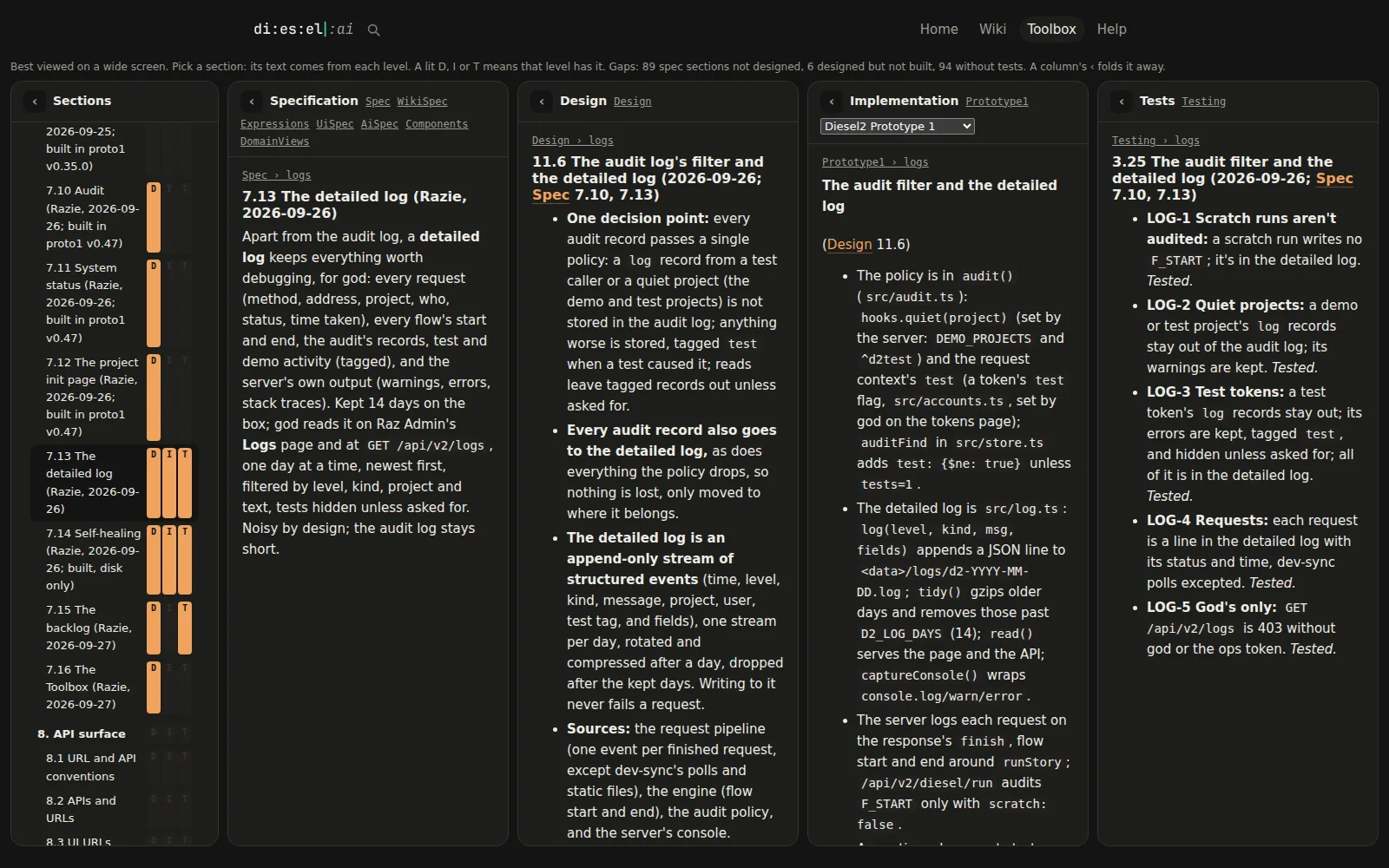
Tap the picture for the full size.
The system view (/system, in the Toolbox) shows your whole project side by side, feature by feature: what each feature is meant to do, how it's designed, how it's built and how it's tested. Above is d2's own, with the detailed log open in every column.
Live, while your AI works
The view is real time: every time your AI saves a topic or a draft, the view follows within seconds, no setting needed: new sections appear in the list, the gaps update, and the section you're reading refreshes. You watch the work instead of asking about it.
- Auto-scroll (the toggle above the columns, on by default): when a section is added or changed, the view goes to it and flashes it in the list. It moves at most every ten seconds, and never while you're scrolling, typing or just after you opened a section yourself.
- Next change: changes you haven't seen wait in a queue, in the order of the list; the button shows how many and takes you to the next one at once. Pressing it pauses auto-scroll (it says paused) until you turn the toggle on again.
Every feature, at every level
- Five columns: Sections (the list of features), Specification, Design, Implementation (a picker if there's more than one) and Tests. Each column folds to a strip with ‹ and opens again with ›, so it works on a smaller screen too.
- Click a feature in Sections and every column shows that feature's section, so you read what it should do next to how it's designed, built and tested. Only the sections you open are loaded, so the view opens fast however big the project is.
- Keep reading at the end of a section loads the ones after it.
- When a level doesn't have that section, its column keeps what it was showing and says so on top. If it had nothing yet, it shows that level's whole topic, near the closest heading.
- D, I, T next to a feature light up when the design, an implementation or the tests have it. A pale letter is a gap.
- Gaps are counted at the top: features not designed, designed but not built, and without tests. It's the to-do list nobody had to write.
- Links that open on a feature:
/system?show=logs,log-6opens on the first and queues the rest behind Next change (anything it can't find is listed); add&cols=spec,teststo show only those columns for that visit. Your AI can end its report with one, so you walk through exactly what it changed. - Behaviour by behaviour: inside a feature, each promised behaviour has a code (
LOG-6), and the other levels point back to it. The Feature list (/features, in every project's Toolbox) shows every behaviour against the levels, so you can tell exactly which one isn't tested yet.
How it knows what lines up
- Levels are topics, by tag:
d2-spec(what it does),d2-design(how),d2-impl(each implementation's notes),d2-test(the tests). Tag your topics and the view finds them. - Features line up by id: a section's heading ends with a short id,
## The detailed log {#logs}, and the same id is used in the design, implementation and test sections of that feature. A section can also link to the one it answers:the design of [[Spec#logs]]. - Behaviours by code: a spec line ends with its code,
^log-6, and the others link to it with[[Spec#^log-6]]. Write^log-and d2 gives it the next number when you save. - Ask your AI to work this way. The diesel2 skill tells it to: one feature at a time, every level updated together, the same id everywhere. See projects for the four topics every project keeps.
Today
The system view runs on d2spec, d2's own specification; every project gets its own soon (it's on d2's to-do list). The Feature list already works in every project: in a small one that keeps everything in its AiSpec:PROJECT, a line counts for design, implementation or tests by the heading it sits under.